




Additional information
| Weight | 0,430 kg |
|---|---|
| Dimensions | 21 × 6 × 19 cm |
26,00 €
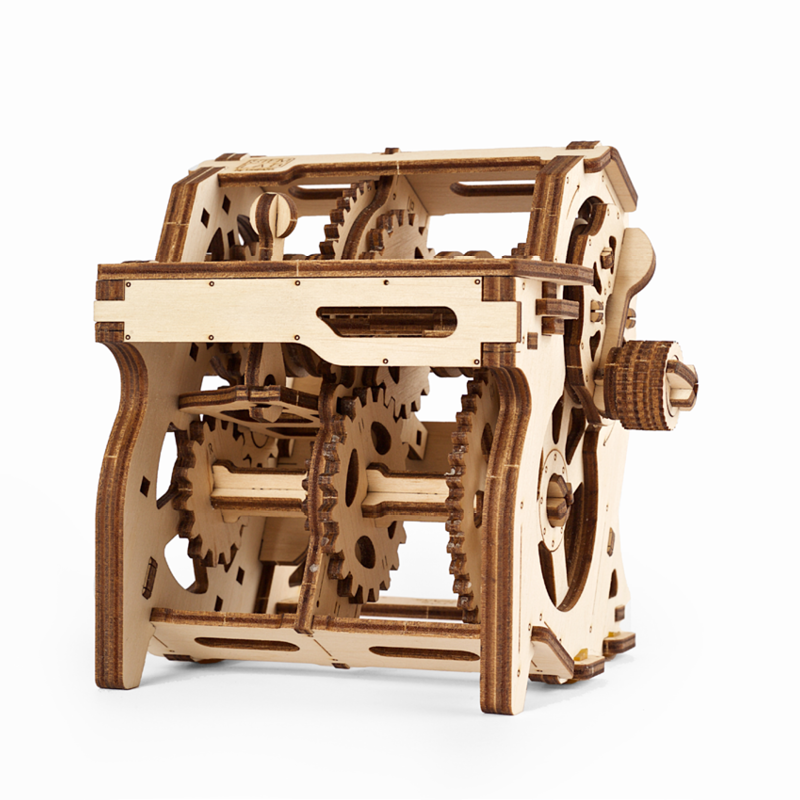
It is high time to start a consistent, steady stream of fun with a UGears STEM LAB Pendulum. Get ready for measured challenge and enlightenment with this stylized educational model that makes learning the essentials and principles of working pendulums easy and entertaining for all ages. Whether you’re interested in the mechanism that makes mechanical clocks tick or the element that keeps metronomes steady and musicians in tempo, the Pendulum is sure to give you hours of fun in construction and exploration.
Now known as one of the most basic and reliable time-measuring mechanisms, the pendulum was first studied by Galileo Galilei, an Italian engineer at the end of the 16th century, who described how the mechanism kept oscillations, or movements back and forth at a constant speed, consistent. A Dutch physicist, Christiaan Huygens, built on Galileo’s work by using a pendulum in a mechanical clock in the 17th century. In addition to clocks and metronomes, pendulums are also used today in geological surveying, seismography, sports, and laboratory research in mechanics and physics.
Start out by building your Pendulum model using the Pocket Model’s Study Guide to discover the principles of a working mechanical pendulum. You’ll surely admire the precise inner mechanisms of the model, such as the anchor escapement that controls the frequency of oscillations, the weight, the scrape-wheel, the gearing, the rubber-band, and the ratchet and pawl. The working model has multiple ways to control the frequency of oscillations, and you’ll have fun learning how to use the weight of the pendulum bob, the vertical position of the weight on the pendulum, and the tension of the rubber band to control the pendulum’s movement back and forth.
After successful construction, lose yourself in Augmented Reality to discover how the pendulum is used to make a clock tick. Interacting with your Pendulum via your UGears application, study the working principle of your model. You’ll observe that the force of gravity and the potential energy of the rubber band work together to keep the amplitude of oscillation constant with the rubber band compensating for the pendulum’s oscillations’ kinetic energy loss. For additional enrichment, make sure to spend time reviewing the included creation story and engaging in the included tasks in the interactive study guide.
Each Pendulum model allows for self-assembly from the parts, which are pulled out from wooden boards according to easy-to-follow manual instruction. The models don’t require glue or cutting, which makes them a perfect model for younger children to enjoy with their adult scientific exploration partners or for teenagers to build and use with some guided help from their parents. For additional fun and customization, paint your model with watercolor paints. This high-quality model kit promises hours of family entertainment and bonding.
Model Size: 4.5 x 3.3 x 6.6 in
Package size: 8.1 x 7.4 x 2.5 in
Number of parts: 92
Level: Easy
Assembly Time: 2 hours
Recommended Age: 8+
Kit weight: 1.00 lbs
Out of stock
| Weight | 0,430 kg |
|---|---|
| Dimensions | 21 × 6 × 19 cm |


